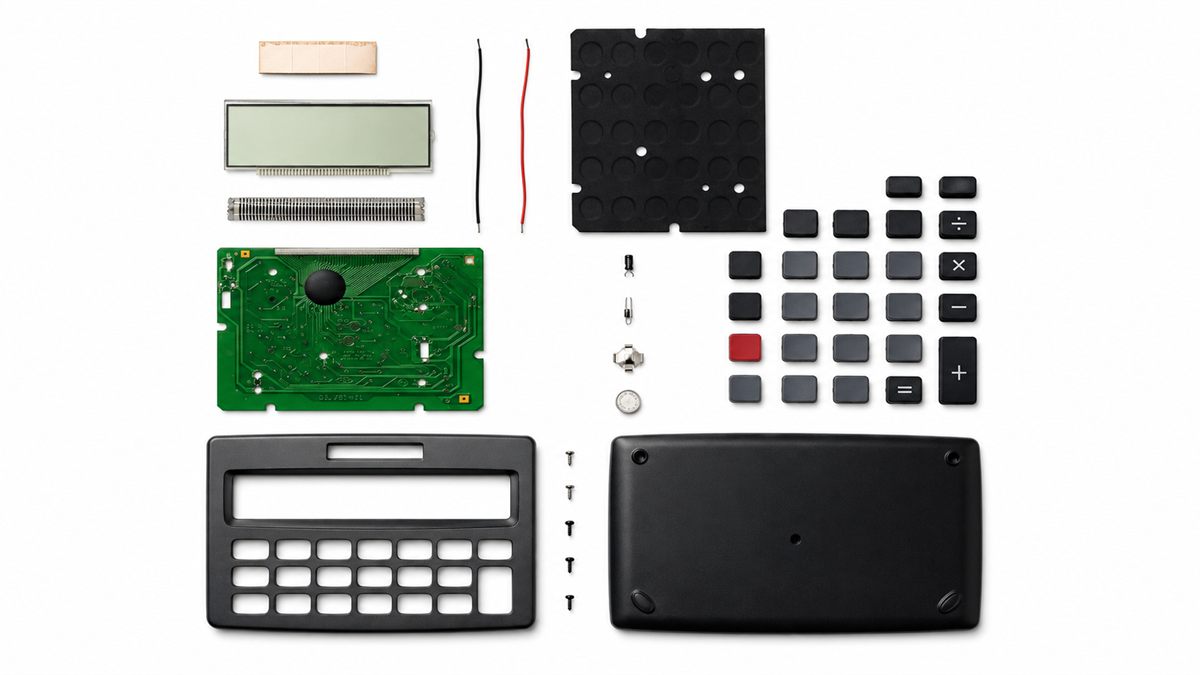
Determining the plastic composition of one complex electronic or electrical product can be difficult.
For a company with hundreds or thousands of SKUs, the task can quickly become overwhelming.
Federal Plastics Registry reporting for electronic and electrical equipment (EEE) may require companies to account for plastics contained in components such as casings, cables, connectors, circuit-board materials, insulation, switches and internal structural parts.
However, companies often lack the information needed to determine the weight of those plastics, the resin types involved and the source of each resin.
Supplier data may be incomplete, bills of materials may not be available, and product specifications rarely provide the level of detail needed for FPR reporting.
While it may be possible to investigate one product in depth, repeating that analysis across an entire catalogue can become unmanageable. This is where a structured calculator can be especially valuable.
What the FPR Guide says about calculation methods
The Guide for reporting to the Federal Plastics Registry illustrates several approaches for determining plastic quantities in EEE.
These include specific component identification, an average bill of materials and a fixed-factor calculation.
For example, the Guide illustrates an average bill-of-materials method using drills with similar compositions. It also provides a fixed-factor example for printers based on the average plastic content and resin distribution identified from a range of products.
These examples do not remove the reporting party's responsibility for its calculations. They do, however, reinforce an important point: a reasonable methodology may be applied across sufficiently similar products when complete information is not available for every SKU.
The Federal Plastics Registry Notice also requires reporting parties to identify the method used to determine the quantities they report. A calculator should therefore do more than produce a number. It should form part of a documented methodology.
Applying calculators across product groups
Large catalogues usually contain natural product families.
Products may share a common construction, supplier platform, model generation, size range or functional design. These similarities may allow one methodology to be applied across a defined group while still using product-specific inputs.
The goal is not to force every product into the same calculation. It is to create enough product groups to reflect meaningful differences without turning every SKU into a separate research project.
Documentation should remain connected to each SKU
Even when multiple products share a calculator, the reporting trail should remain available at the product level.
This creates a clear connection between the final aggregated FPR totals and the underlying products.
The FPR Guide states that obligated reporters must retain detailed records of their data and calculations for three years after the reporting deadline. Maintaining a product-level calculation trail can therefore support internal review, future updates and the preparation of supporting documentation.
EEE packaging creates a related challenge
EEE companies may also need to determine the plastic contained in their product packaging.
Packaging information can be just as difficult to obtain as product-composition data. A company may know the total packaged weight or product dimensions but lack a complete breakdown of trays, films, bags, foam, cable ties and other plastic packaging components.
Circular Sky has developed an EEE packaging calculator to help address this problem. It is designed to support documented calculations across appropriate product groups when complete supplier data is unavailable.
The methodology can be applied across related products while maintaining a record of which SKUs used the calculator and how their results were determined.
Key takeaway
One complex EEE product can be difficult to assess. A large catalogue can become overwhelming.
Documented calculators provide a way to move from one-product-at-a-time research toward a more structured reporting process.
This does not eliminate the need for judgment or reliable source information. It makes the process more consistent, scalable and traceable.
For EEE companies facing incomplete product or packaging data, that can be the difference between a collection of disconnected assumptions and a repeatable Federal Plastics Registry reporting process.
At Circular Sky, we help EEE companies organize product and packaging data, apply documented calculation methodologies across product groups and generate supporting records for Federal Plastics Registry reporting. A centralized data system with built-in calculation capabilities can make this process far more manageable than relying on spreadsheets alone. Learn more about Circular Sky's FPR data and filing support.
References:
Government of Canada, Guide for reporting to the Federal Plastics Registry – phase 1.
https://www.canada.ca/en/environment-climate-change/services/managing-reducing-waste/reduce-plastic-waste/federal-plastics-registry/guide-reporting-phase-1.html
Government of Canada, Notice with respect to reporting of plastic resins and certain plastic products for the Federal Plastics Registry for 2024, 2025 and 2026.
https://gazette.gc.ca/rp-pr/p1/2024/2024-04-20/html/notice-avis-eng.html